
Menu
The Do’s and Don’ts of Pouring Concrete in Miami Gardens
Pouring Concrete Miami Gardens
Completing concrete projects in Miami Gardens requires understanding the unique challenges presented by South Florida’s tropical monsoon climate. Temperature extremes, high humidity levels, and frequent afternoon thunderstorms create conditions that demand special attention during installation. Homeowners near Buccaneer Park and neighborhoods throughout Carol City have learned that proper techniques in pouring concrete make the difference between durable surfaces and premature failures. Professional contractors recognize that Miami Gardens’ weather patterns significantly impact curing processes and final strength development. Following proven best practices ensures your investment delivers decades of reliable performance while avoiding costly mistakes that compromise structural integrity.
Schedule Your Installation When the Weather Is Best
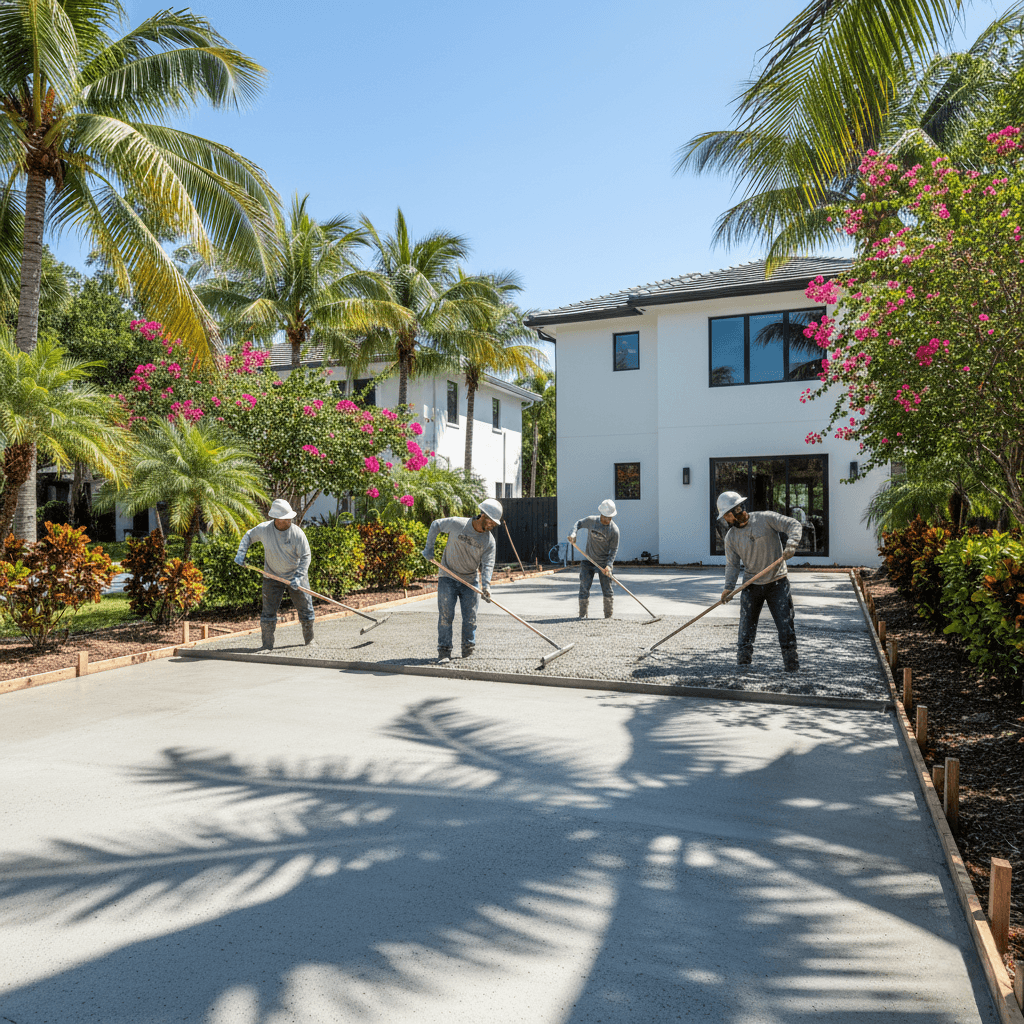
Miami Gardens’ climate poses significant risks to concrete installations. The best opportunity to complete an installation occurs during the cooler morning hours (between 6 a.m. and 10 a.m.) when there are lower evaporation rates and cooler temperatures. Checking the weather forecast will help you avoid pouring during bad weather or extremely hot conditions. Properties located near Andover Park can schedule their install within the drier months (November to April) to ensure a more predictable condition. In addition, the installer needs to monitor the humidity level to ensure that the moisture does not evaporate too quickly or too slowly.
Avoid Pouring When There is Extreme Heat or Rain
When the temperature exceeds 90 degrees Fahrenheit, you will encounter several problems that negatively affect the finished surface. The heat accelerates the setting time of the concrete and limits the amount of time you have to finish and level the surface. When rain falls on uncured concrete, it dilutes the concrete mixture and washes away some of the cement; as a result, you will have a weak surface and possible weak areas throughout the entire slab. As demonstrated by the weather conditions in the neighborhoods surrounding Lake Lucerne, afternoon storms may develop rapidly during the summer months. Instead of risking the loss of the project, professional contractors wait until the weather has improved to pour the concrete.
Prepare the Job Site Correctly
Preparation of the job site is a crucial step in preparing for a successful concrete installation throughout Miami Gardens. Eliminating all vegetation, debris, and loose soil eliminates potential settlement issues that may lead to cracks in the surface of the slab and/or an uneven surface. By compacting the subgrade, you create a solid base that will provide stability for the weight of the concrete and for whatever will be placed on top of it. A gravel base layer adds drainage capabilities to the job site and also increases the structural support of the slab. Residents living in neighborhoods surrounding Scott Lake need to pay close attention to the soil conditions that exist on their property and the additional preparation steps that may be required due to higher moisture content in those soils.
Use Adequate Reinforcement Materials
Concrete installations that do not use enough reinforcement will fail prematurely because of excessive cracking. Steel rebar installed on properly spaced rebar will add tensile strength to the concrete, which will keep large cracks from forming. Wire mesh is another type of reinforcement that is commonly used for smaller residential concrete installations, such as patio and walkway installations. Fiber additives added to the concrete will improve crack resistance and the overall durability of the concrete. For example, properties located in the neighborhoods surrounding Bunche Park have many examples of projects where the inclusion of adequate reinforcement extended the life of the surface by decades compared to projects that did not include adequate reinforcement.
Choose the Right Type of Concrete Formulation
By choosing the right type of concrete formulation that is designed for the climate conditions found in South Florida, you can maximize its performance in the environment found in Miami Gardens. Air-entrained mixtures include small air bubbles that allow for the thermal expansion and contraction cycles of the concrete. Lower water-to-cement ratios produce stronger concrete that is less prone to moisture intrusion and surface scaling. Retarding admixtures slow down the setting time of the concrete when the temperature is elevated, giving you sufficient working time to complete the finishing requirements. High-performance blends of concrete typically include supplemental materials that will provide greater durability against the heat and humidity challenges found in Miami Gardens.
Do Not Increase the Amount of Water in the Mix
Adding more water to the mix than what was originally recommended will compromise both the strength and durability of the concrete. While a wetter mixture may seem easier to work with and spread, it will produce a weaker bond between the cement particles. Adding excess water to the mix will increase the amount of shrinkage that occurs as the concrete cures, producing larger crack patterns. Surface scaling and early deterioration of the surface will occur more frequently when using too much water in the original mixture. Even if the conditions become difficult to finish, experienced contractors will continue to follow the original water ratio to provide long-term performance.
Provide Sufficient Moisture During the Curing Process
Providing the right amount of moisture during the curing process is important to achieve the maximum strength of the concrete. Immediately applying a curing compound to the finished surface will seal the surface and slow down the rate of moisture evaporation. Wrapping freshly poured concrete with wet burlap or plastic sheeting will help maintain the needed hydration levels to allow the crystals to form properly. Spraying the surface with water regularly during the first week will prevent the surface from drying out too quickly, which would weaken the slab. Neighborhoods located near Norland have been able to obtain better results from extended curing times that allowed the concrete to reach the intended design strength.
Do Not Remove Forms Too Quickly
Removing forms too quickly will cause the concrete to sag, crack, or fall apart before it reaches the required strength. Forms should be left in place for a minimum of 2 to 3 days, but longer is always better. If you remove the forms too quickly, it will undermine all the hard work and money spent on the installation process. The high humidity found in Miami Gardens can create false impressions regarding surface conditions. The surface may appear dry, while other areas of the interior of the slab are still not sufficiently cured. Rather than risking structural damage, patient contractors will allow the concrete to develop the required strength before removing the forms.
Install Control Joints Properly
Control joints are strategically placed in the slab to direct cracking to specific locations instead of allowing it to crack randomly throughout the slab. Control joints should be cut to 1/4 of the thickness of the slab at regular intervals corresponding to the thickness in feet. The spacing of control joints depends on the size of the slab and the thickness of the concrete. It is recommended to space control joints every 8 to 12 feet for standard residential applications. Scoring or sawing weakened planes will guide the cracking of the concrete to acceptable locations. Properties located near Opa-locka North have shown that installing control joints properly maintains a nice appearance of the concrete while allowing the concrete to move naturally.
Do Not Forget About Drainage
If you do not take into consideration adequate slope and drainage for the concrete installation in Miami Gardens, the performance of the concrete will suffer greatly from the high rainfall in the area. All surfaces should slope at a minimum of 1/4 inch per foot away from structures. Providing a proper drainage system will eliminate standing water from accumulating under the slab and causing erosion and structural damage. Standing water will accelerate the deterioration of the concrete through freeze/thaw cycles and chemical reactions occurring between the concrete components and water. The professional contractors will account for the high annual rainfall in Miami Gardens and plan accordingly to ensure that the water drains away from the slab properly.
Protect the Surface of the Concrete
Protecting the surface of the concrete will give it the protection it needs to withstand the harsh environmental conditions found in Miami Gardens. Penetrating sealers will protect the concrete from moisture invasion while allowing for vapor transmission from underneath the slab. UV-resistant coatings will protect the color of the concrete from fading and deterioration caused by the intense sunlight found in Miami Gardens. Anti-spalling treatments will protect the edges and corners of the slab from chipping and deterioration. The application of protective sealers regularly will provide a barrier on the surface of the concrete and will extend the lifespan of the surface by many years compared to the unprotected surface.
Expert Contractors Ensure the Best Results
Successful completion of concrete projects requires an expert contractor who understands the materials and techniques involved in the process. In addition, the contractor must understand the unique climate challenges found in Miami Gardens to properly plan and avoid common pitfalls. Contractors who have experience working in Miami Gardens and have developed a reputation for delivering quality products and services know when conditions are favorable to proceed with the installation and when to delay to protect the quality of the final product.
At Miami Gardens Concrete Pros, our company brings over 50 years of combined experience in specialized concrete contracting throughout Miami Gardens. Our goal is to provide quality products and services to our customers that will last for many years to come in the challenging climate of South Florida.
LATEST POSTS